Macro
WEO 2025: Geopolitics, Critical Minerals, and the Price of Global Energy Security
The latest edition of the World Energy Outlook (WEO-2025) by the International Energy Agency (IEA) comes at a time when energy is increasingly at the center of political and geopolitical tensions. While the links between energy and politics have always been tight, energy security risks today apply to a range of fuels and technologies never seen before. Energy security is now a matter of economic and national security.
Governments are facing a formidable array of threats and vulnerabilities, extending far beyond oil and gas to include electricity, infrastructure, technology supply chains, and critical minerals.
The Systemic Risk of Critical Minerals
Critical minerals represent a central theme in WEO-2025, highlighting new vulnerabilities in energy security. The IEA was the first to underscore the risks arising from the high concentration of critical mineral supplies, especially in refining and processing stages. A single country is the leading refiner for 19 out of 20 strategic minerals linked to energy, holding an average market share of about 70%. This reliance on a small number of suppliers increases risks of supply disruptions or economic coercion.
These minerals are crucial not only for power grids, electric vehicles (EVs), and batteries but also for strategic sectors like AI chips, automotive, and defense. Such risks are no longer theoretical but a concrete reality, with implications reflecting on millions of jobs. Urgent action is needed immediately to strengthen preparedness against potential disruptions and in the long term to diversify supply chains and reduce structural risks. A further risk element is that, as of November 2025, over half of these strategic minerals are subject to some form of export control.
The Age of Electricity: Impacts on Infrastructure and Investments
In all IEA scenarios, electricity demand grows much faster than overall energy use. This growth is driven by increased use of appliances, air conditioning, advanced manufacturing, and, increasingly, data centers and AI.
Investors are responding to this macro-trend: spending on electrification and electricity supply already constitutes half of current global energy investments.
- The Digital Overtake: Investments in data centers are expected to reach $580 billion USD in 2025, a figure exceeding the $540 billion USD spent on global oil supply. This marks an eloquent indicator of the shift occurring in digitized economies.
- Grid Vulnerability: Despite the acceleration in investments for electricity generation (grown to $1 trillion USD annually since 2015), annual spending on power grids has increased at less than half that pace ($400 billion USD). This lag is creating bottlenecks, slowing the connection of new generation sources and demand (like data centers, which will triple electricity consumption by 2035) and pushing electricity prices upward.
Scenarios and Implications for Commodities
WEO-2025 uses three main scenarios (CPS, STEPS, and NZE) to explore future trajectories.
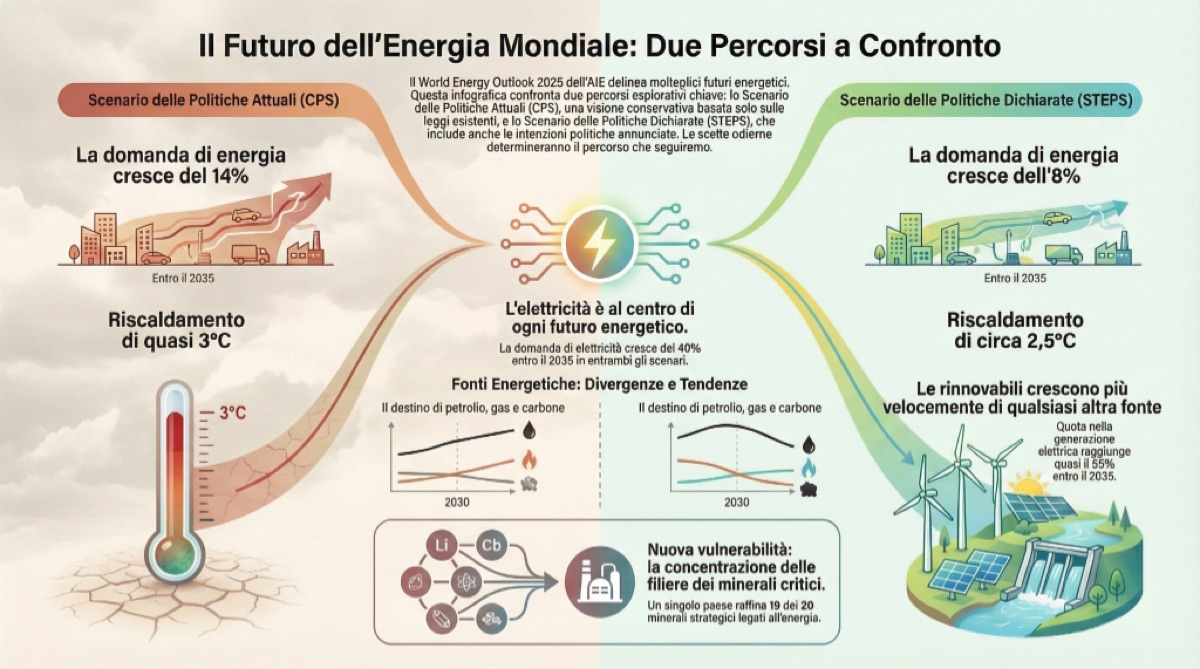
Here are the key implications for markets:
| Scenario | Climate Goals (Temp by 2100) | Fossil Fuel Demand | Market Implications |
|---|---|---|---|
| CPS (Current Policies) | ~2.9°C | Continues to grow until 2050 (Oil & Gas) | Requires new projects (25 mb/d by 2035), pressure on investment/prices. |
| STEPS (Stated Policies) | ~2.5°C | Oil flattens around 2030 (102 mb/d) | LNG supply glut (~65 bcm) in 2030 due to slowing EU/China demand. |
| NZE (Net Zero) | Peak 1.65°C -> <1.5°C | Sharp decline for all fossil fuels | Rapid transformation and massive use of CDR technologies. |
In all scenarios, renewable energies (led by solar PV) are the fastest-growing energy source. Nuclear is also making a comeback, with global capacity set to increase by at least a third by 2035. The success of this transition, however, will depend on the ability of policymakers to address the growing complexity of markets and provide clear data and analysis to navigate an increasingly uncertain and dangerous world.
Multimedia Insights
📄 Full Presentation (PDF)