Psychology
The Capital Architect: How the World's 111 Richest Families Think
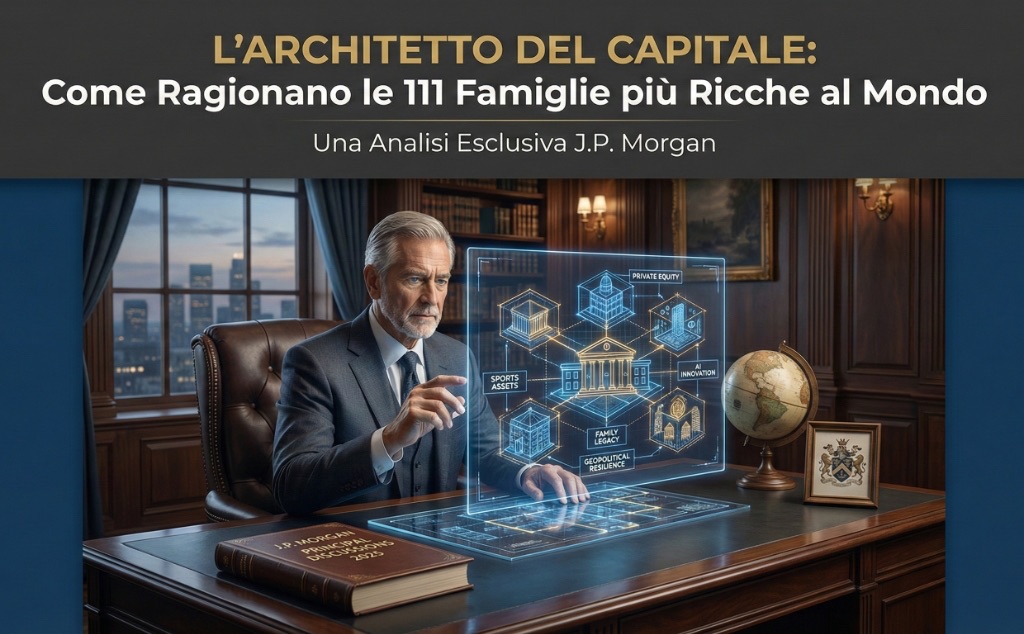
There is an abyss between how the retail market perceives wealth and how real Smart Money manages it. While the masses get lost in the noise of 5-minute technical analysis or the latest memecoin, there is a market segment that does not seek rapid returns, but the construction of resilient empires.
J.P. Morgan Private Bank recently conducted a survey of 111 "Principals" – patriarchs and decision-makers of ultra-high-net-worth families with a collective wealth exceeding $500 billion.
The result of the "Principal Discussions 2025" report is clear: the passive "rentier" model is dead. We are in the era of the Intentional Architect. It is no longer about guarding wealth, but about actively shaping the ecosystem in which it resides.
Here are the 5 structural trends driving the portfolios of the world's most powerful families, stripped of background noise.
1. Private Equity: The Death of Passive Management
The first data point is a cold shower for supporters of passive ETFs and the classic 60/40 portfolio.
The Principals are stepping out of the spectator role to become protagonists.
- The Data: 70% prefer active roles in direct investments (a vertical growth from 43% in 2022).
- The Analysis: The number of families increasing exposure to Private Equity is double those reducing it. They don't just finance companies; they leverage their entrepreneurial know-how to restructure them. While retail buys the stock hoping it goes up, the institutional investor buys the company to make it go up. It's the return of alpha generated by operations, not speculation.
2. Alternative Asset Classes: Sports as a Cash Cow
Forget the idea of the sheikh or tycoon buying a football team for vanity. In 2025, sports is an uncorrelated asset class, recession-resistant with predictable cash flows (TV rights, merchandising, real estate).
- The Data: 20% of Principals own controlling stakes in sports teams (compared to a meager 6% in 2022).
- The Analysis: Sports ownership has become the perfect glue between institutional capital and family legacy. It is a "trophy" asset that nonetheless bills like a multinational. It is real diversification in a market saturated with synthetic financial products.
3. AI: Implementation vs. Speculation
While the stock market inflates on the bubble of hype related to Artificial Intelligence, the super-rich have a pragmatic approach: they don't just bet on chip manufacturers, but integrate technology to increase margins.
- The Data: 79% use AI in their personal lives and 69% actively employ it in their operating companies.
- The Analysis: For these families, understanding AI is not an option for trading, it is a necessity for industrial survival. The goal is operational efficiency, not short-term capital gain on the stock of the moment.
4. The Real "VIX": Geopolitics
Ask a retail trader what the biggest risk is and they will answer "inflation" or "Fed rates". Ask those who manage 500 billion and they will answer: Geopolitics.
- The Data: 56% identify geopolitical tensions as the number one risk.
- The Analysis: In a fragmented world, the answer is not asset liquidation (fear), but jurisdictional diversification. Not putting all your eggs in the same political basket is the real hedge. Global resilience beats the search for maximum local yield.
5. Governance: Human Capital Before Financial Capital
The most contrarian point concerns internal management. Money is considered a commodity; family cohesion is the scarce asset.
- The Data: 73% of family members are involved in the business, but access is based on meritocracy, not birthright.
- The Analysis: Advanced technologies (including AI holograms of founders) are used to pass on the legacy, and philanthropy is managed with corporate KPIs (70% have dedicated teams). The goal is to avoid the classic dissipation of wealth by the third generation.
Multimedia Insights
📄 Full Presentation (PDF)
The PizzaForex Takeaway
The lesson emerging from these 111 conversations is brutal in its simplicity: "The currency of life is time, not money".
The average retail investor trades their time to try to get money from the markets. The high-level institutional investor uses money to buy time, control, and impact. Enduring Success is not found in the year-end P&L, but in the ability to build structures that survive market cycles and geopolitical turmoil.
If you want to operate like Smart Money, stop looking only at price and start looking at value, control, and structure.