Macro
Berkshire Hathaway's Liquidity Tower: An Institutional Analysis of Currency Risk and Leadership Transition
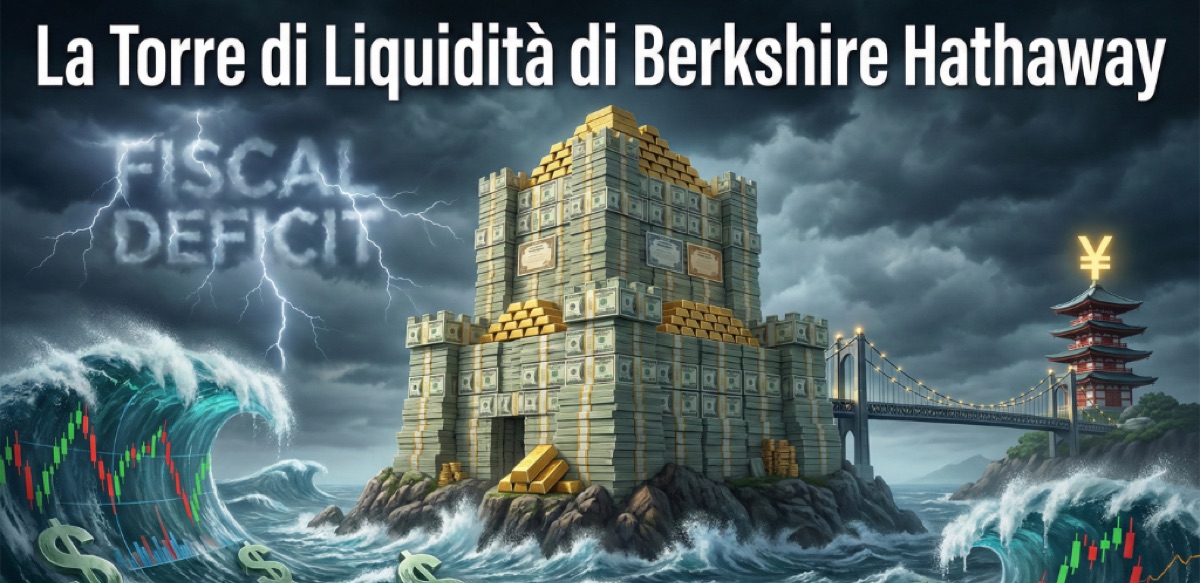
The recent annual shareholder meeting of Berkshire Hathaway provided essential insights for institutional investors and macro analysts, particularly regarding the holding's enormous pile of cash, the systemic risk of the US currency, and hedging strategies in foreign currencies like the Japanese Yen (JPY).
The War Chest and Capital Allocation Strategy
Berkshire Hathaway currently holds over $300 billion in cash and short-term investments, an amount representing about 27% of total assets (well above the historical average of 13%). This massive reserve includes nearly 5% of the entire US Treasury market.
The decision to maintain such a level of liquidity is not primarily a risk mitigation strategy linked to the leadership transition to Greg Abel, but rather the result of a market offering few attractive opportunities. Buffett reiterated that the investment business does not offer opportunities in an orderly fashion. Liquidity is a strategic asset, crucial for being ready to act quickly when extraordinarily attractive opportunities arise, which happens only "very occasionally." Although BRK would prefer to have a lower reserve (e.g., $50 billion), the strategy of not being fully invested at all times has generated profits.
Regarding future capital allocation, designated successor Greg Abel confirmed that the investment philosophy will remain unchanged: maintain reputation, ensure a "fortress" balance sheet, and commit capital based on very long-term economic prospects (5, 10, or 20 years).
The Macro Alarm: Government Debasement
A central macroeconomic theme raised was the intrinsic risk of currency. Buffett expressed strong concern regarding US fiscal policy, defining it as what scares him.
He issued a peremptory warning, applicable to all political systems: a government's tendency to want to debase its currency over time is a force that no system manages to defeat. He summarized that the natural course of government is to make currency less valuable over time. This dynamic is aggravated by the fact that the United States operates with an unsustainable fiscal deficit over a very long period (a gap of about 7%, when likely a 3% gap would be sustainable).
The value of currency is "a scary thing," and it is extremely difficult to introduce checks and balances into the system to prevent its devaluation. According to Buffett, if one had to choose a way to ruin the country's economic success, it would be through the currency.
The Hedged Position on the Japanese Yen (JPY)
Berkshire's position in Yen is not a speculative bet on Forex, but a very long-term financing strategy.
- Ultra-Long-Term Investment: BRK purchased significant stakes in five major Japanese trading companies (initially bought at "ridiculously low" prices). The intention is to hold these stakes for an extremely long period, estimated at "50 or 100 years or more".
- Low-Cost Financing: BRK issued liabilities denominated in JPY because the financing situation in Yen was considered "so cheap".
- Currency Hedging: Using Yen loans serves to match purchases of Yen-denominated assets with Yen-denominated financing. This matching strategy acts as a hedge and is not Berkshire's usual policy, but was implemented for the first time precisely for this situation, combining fundamental confidence in Japanese companies with the low cost of carry.
Sector Risk: Insurance, AI, and Private Equity
In the insurance sector, led by Ajit Jain, profound transformations are underway:
- Disruption by AI and Autonomous Vehicles: Artificial Intelligence (AI) is seen as a "game-changer" that will radically modify risk assessment, pricing, and transfer. Autonomous vehicles will change the auto insurance business, shifting emphasis from "operator errors" (the human driver) to "product liability" (the manufacturer or autonomous software). Geico is in an advanced stage of adaptation, having recovered the technological gap on telematics and reduced the workforce by 20,000 units.
- Competition from Private Equity (PE): Large PE funds (like Blackstone, Apollo, KKR) have become very active in the insurance segment (particularly in life insurance), using greater leverage and more aggressive investment strategies compared to BRK. Buffett and Jain believe they are no longer competitive in this space, noting that while PE funds realize profits in a solid economy, there is a risk that an economic downgrade could end in "tears" for these situations, posing risks for policyholders.
Multimedia Insights
📄 Full Presentation (PDF)