Technical
Akwel SA: How to Read a Deep Value Case

Educational case study with December 2025 data. Not an invitation to buy or sell the stock.
There is an old saying on Wall Street: "Buy when blood is running in the streets, even if it is your own." Today, in 2025, blood is flowing copiously in the European automotive sector. Between an uncertain electric transition and falling earnings, sentiment is extremely pessimistic.
However, it is precisely in these scenarios of "total liquidation" that the most interesting asymmetries emerge. Today we put Akwel SA (AKW.PA) under the lens, a French small cap that the market values far below its assets.
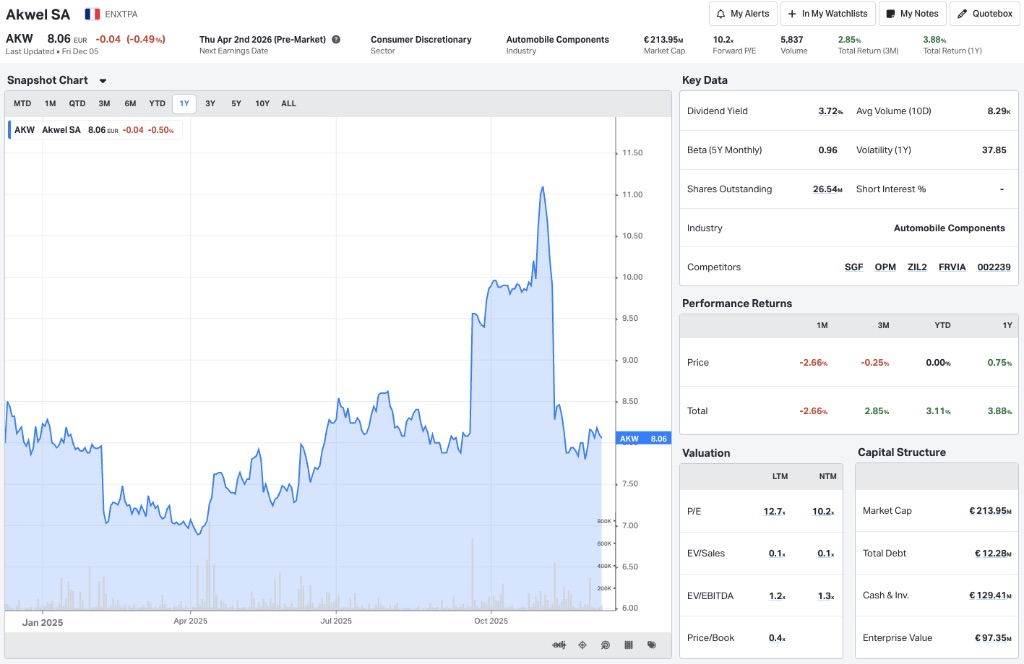
Here is why it is a textbook "Graham Style" case.
1. The Catalyst: Why Watch It Now?
The market hates uncertainty. With sector earnings down 50% year-on-year, investors have fled indiscriminately. This has compressed Akwel's valuations to levels implying imminent bankruptcy. But the market is making a crucial mistake: it is looking only at the Income Statement (suffering) while ignoring the Balance Sheet (extremely solid). In a case like this, the risk of permanent loss is mitigated by a mountain of cash.
2. The Numbers: Why Is It Worth More?
We are not talking about a bet on growth ("Growth"), but a pure calculation of asset value ("Asset Play").
- Benjamin Graham Style Discount: Akwel trades at 0.66x Net Current Asset Value (NCAV). In simple terms: you are buying €1 of liquid assets (cash + inventory + receivables - all liabilities) paying only 66 cents. In fact, the operating business (factories, machinery, patents) is given to you for free.
- Zero Enterprise Value: With a market cap of approximately €181M and a positive Net Financial Position (Net Cash) of ~€118M, the real enterprise value is ridiculous. The EV/EBITDA multiple is a measly 1.30x.
- The Margin of Safety: The Tangible Book Value is €24.46 per share. The stock today trades around €7.88 - €8.06. Even assuming a scenario of perpetual stagnation, the gap between price and real value is immense.
3. Skin in the Game
Another safety factor is ownership. The founding family still holds 70% of shares. This means that management is not composed of mercenaries: their interests are totally aligned with those of the other shareholders. They have every interest in not destroying the book value of the company.
4. What Can Go Wrong? (The Risks)
Every coin has a flip side. Here is what we must monitor:
- Value Trap: If management fails to improve ROIC (currently stuck at 5%) and burns cash in inefficient operations, the stock could remain "cheap" for years without ever re-rating.
- Auto Sector: Operating margins are compressed (below 4%) and visibility on the sector's future remains low.
- Liquidity: It is an illiquid stock. With a reduced float (~30%), it is not easy to enter or exit quickly with large capital (size).
What this case teaches
Akwel is a textbook example of how a Deep Value analysis is set up. The starting point is not the income statement but the balance sheet: you compare the market price with what the company owns, net of its debts.
- Tangible book value is shareholders' equity without intangible items such as goodwill: in theory, what would be left for shareholders after selling the assets and paying all the debts. The whole case rests on this number.
- The margin of safety is the gap between that value and the price. It is not there to work out how much you could make, but to leave room for mistakes: estimates can be wrong, and some balance-sheet items are worth less than the paper says, like inventory in an industry in crisis.
Then you have to ask why the discount is there. This is where the two risks that weigh most in this case come in.
- The value trap. A stock can stay "cheap" for years. If invested capital earns little (Akwel's ROIC is 5%), the market can keep valuing the company below book value; and if the company burns cash, that value shrinks and the margin of safety thins out on its own. The discount does not tell you if or when the price will move towards the value.
- Low liquidity. With a float of about 30%, few shares change hands: a handful of orders can move the price, and the price on the screen is not always the one at which an order actually gets filled.
That is why a Deep Value analysis does not stop at the discount. The real work is understanding whether that value holds up over time and how easy, or hard, it is to trade the stock. That reasoning, more than the company's name, is what I want to show with this case.
Educational content, not financial advice. No result is guaranteed.